Blog Home / Blog
EOR vs PEO: What Growing Businesses Need to Know Before Hiring Internationally

EOR vs PEO: What Growing Businesses Need to Know Before Hiring Internationally
As more businesses build distributed teams and hire internationally, conversations around EOR and PEO models have become far more common. The challenge is that the differences between them are not always clearly explained, even though choosing the wrong structure can create unnecessary complexity, compliance issues, and operational headaches later.
Both models are designed to help businesses hire internationally, but they work very differently behind the scenes. The right option usually depends on how quickly a business wants to expand, how much internal infrastructure already exists, and how involved the company wants to be in managing employment, compliance, and HR responsibilities directly.
For businesses exploring international hiring for the first time, understanding those differences early can make expansion far smoother and far less risky.
What is an EOR?
An Employer of Record (EOR) acts as the legal employer on behalf of a business. The employee works day-to-day for your company, but the EOR takes responsibility for the legal and administrative side of employment within the country where the employee is based. That includes things like payroll, tax compliance, employment contracts, statutory benefits, and making sure employment practices align with local labour laws. In practical terms, this means businesses can hire internationally without needing to establish their own legal entity in that country first.
What is a PEO?
A Professional Employer Organisation (PEO) works differently. Instead of becoming the legal employer, the PEO operates through a co-employment model, where the business still remains the official employer while the PEO provides support with HR functions such as payroll administration, benefits, and employee support. Because of that structure, businesses generally need to have their own registered legal entity in the country where they want to hire employees. This is one of the biggest distinctions between the two models and usually one of the main deciding factors for businesses comparing them.
The biggest difference comes down to legal responsibility
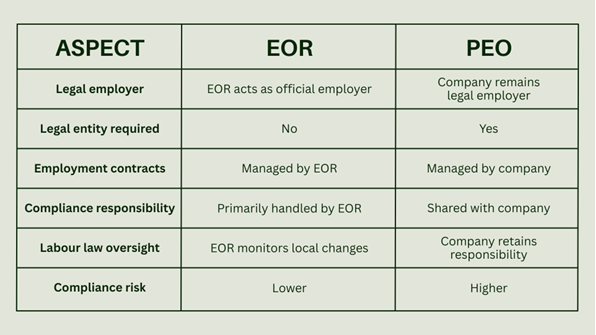
One of the main advantages of an EOR model is that much of the compliance responsibility sits with the provider rather than the business itself. The EOR is responsible for ensuring employment contracts, payroll processes, tax requirements, and statutory obligations align with local laws. That can remove a huge amount of complexity for businesses hiring internationally, particularly in countries where labour laws and tax regulations are unfamiliar. With a PEO, the responsibility is more shared. While the PEO assists with HR and payroll functions, the business still remains the legal employer, which means compliance oversight and liability remain more heavily tied to the company itself.
Speed and flexibility matter too
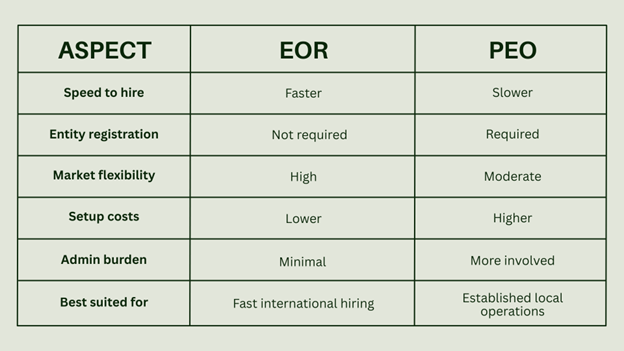
For many businesses, particularly growing companies, speed is one of the biggest reasons an EOR model becomes attractive. Because there is no need to establish a legal entity first, businesses can usually hire internationally much faster. That makes it easier to test new markets, build smaller remote teams, or scale operations without committing to permanent infrastructure immediately. A PEO structure tends to involve a slower setup process because the company must first establish its own legal presence in-country before hiring can begin. That may not be an issue for businesses already operating locally, but it can create additional cost and administrative work for companies entering a new market for the first time.
The employee experience can look very different
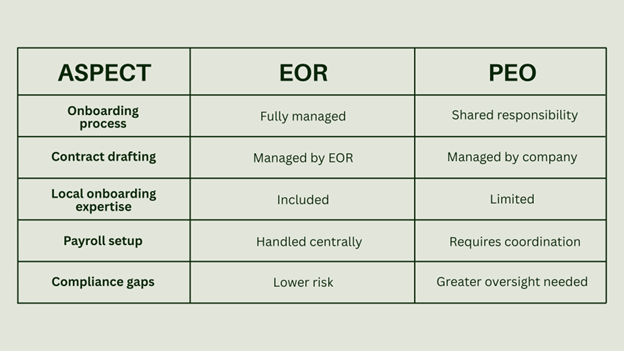
One area that often gets overlooked in these conversations is the actual onboarding and employee experience. With an EOR, the onboarding process is usually far more streamlined because contracts, payroll setup, benefits enrolment, and tax registration are handled centrally through one provider. This helps businesses avoid delays while also giving employees a smoother start. Good EOR providers also bring local expertise around things like probation periods, statutory leave, termination procedures, and mandatory employee benefits, all of which vary significantly between countries. With a PEO, onboarding responsibilities are generally more split between the company and the provider, which can create more coordination and more room for administrative gaps if internal processes are not already well established.
Payroll, tax, and benefits become much easier to manage
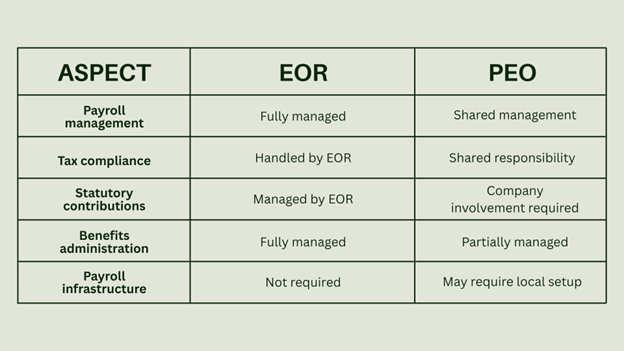
International payroll can become surprisingly complex once multiple countries, tax structures, and statutory requirements are involved. An EOR typically manages payroll end-to-end, including local tax withholding, statutory contributions, employee benefits, and payroll processing in local currency. This reduces administrative pressure internally while also lowering the likelihood of compliance mistakes. With a PEO, payroll and tax responsibilities are usually shared between the company and the provider, which often requires more internal coordination and oversight.
Cost is not always as straightforward as it seems
Cost comparisons between EOR and PEO models can sometimes be misleading because monthly fees only tell part of the story. An EOR may appear more expensive per employee initially, but those costs often include compliance management, payroll infrastructure, legal employment setup, benefits administration, and local expertise. Businesses also avoid the cost and complexity of setting up their own legal entity. A PEO structure can become more cost-effective for businesses that already have a long-term presence in a country and the internal infrastructure to manage parts of the process themselves.
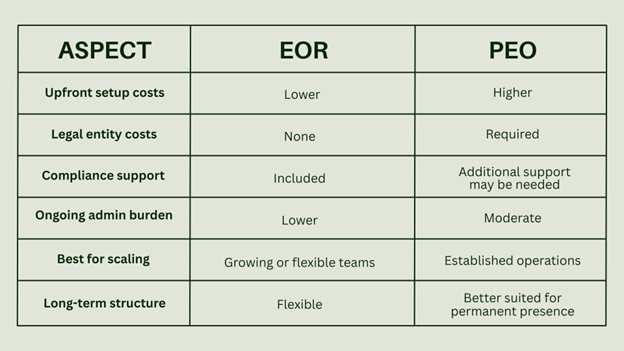
So which option makes more sense?
For many growing businesses, particularly those exploring international hiring for the first time, an EOR model often makes the process significantly easier. It offers flexibility, faster hiring, reduced compliance risk, and less operational complexity, all without requiring businesses to establish a legal entity immediately. A PEO can still be a strong option for businesses that already have a registered entity in-country and want additional HR or payroll support while maintaining greater internal control. The right decision ultimately depends on the structure of the business, future expansion plans, and how involved the company wants to be in managing employment responsibilities internally.
To conclude
International hiring has become far more accessible than it once was, but the structure behind it still matters. Understanding the difference between an EOR and a PEO is an important part of building teams in a way that is compliant, sustainable, and operationally manageable over the long term. At The Talent Team, we help businesses navigate international hiring in a way that feels integrated, people-focused, and built around long-term growth. Whether a company is hiring internationally for the first time or expanding existing distributed teams, the goal remains the same: building strong teams through great people without unnecessary complexity.
Keep Reading



Build a better team without the overheads
Discover how premium South African talent can transform your margins, productivity and growth.